Location
Munich
Study model
conducted on-campus
Duration
4 semesters including thesis
Credit Points
120 ECTS
Total fee
€ 23,850 (including examination fee and immatriculation fee)
Unfortunately no results for your search
Oh no, somethings seems to have the broke the search results. Please try rephrasing your search term!
Master of Science (M.Sc.)


Automotive Systems Engineering & Management (M.Sc.)
You can take on the following jobs:
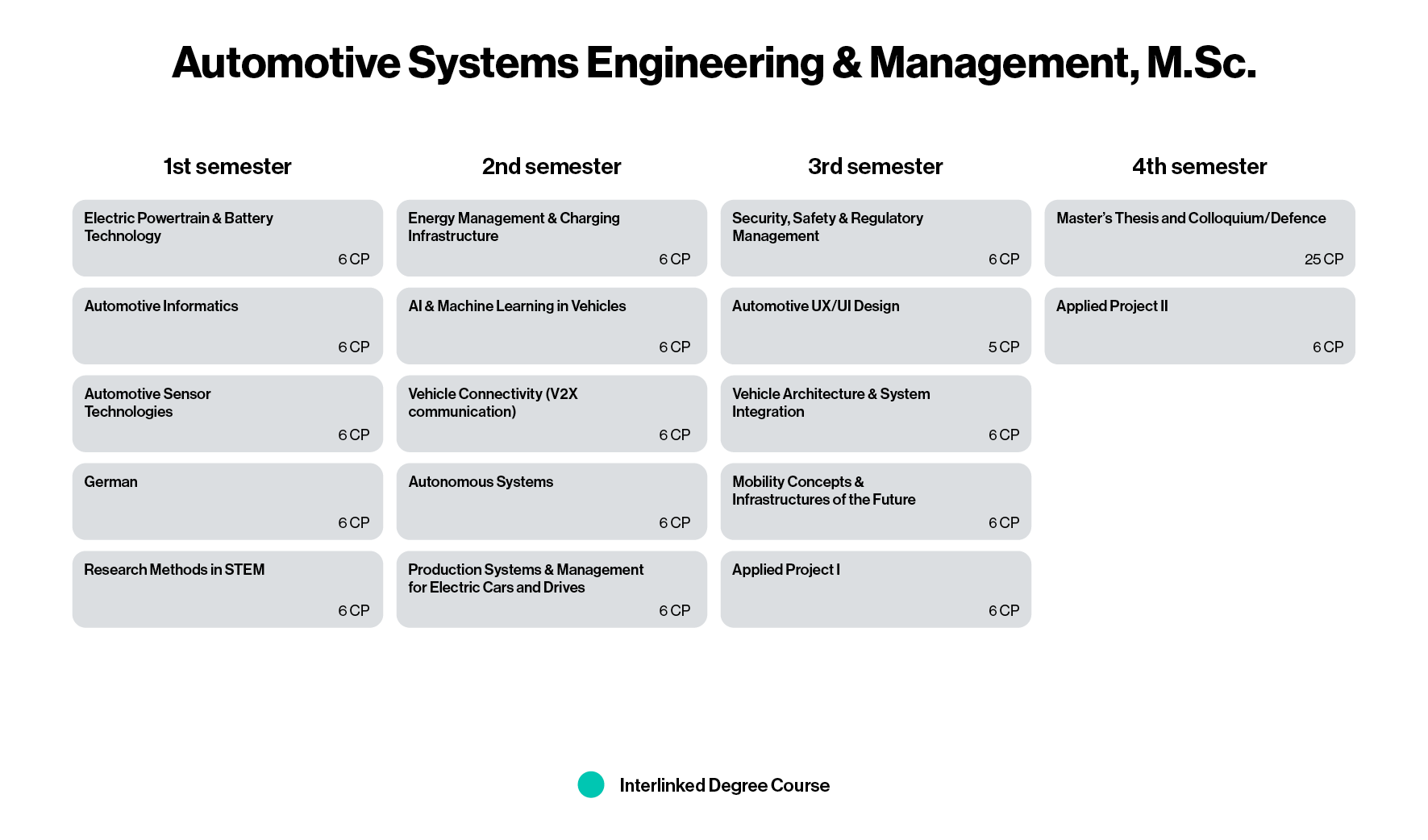
Semester Overview
Electric Powertrain & Battery Technology (6 CP)
Fundamentals of electric drive systems and electric machines used in vehicles
Battery technologies for electric vehicles, including structure, properties, and lifecycle
Integration of battery and powertrain systems into vehicle architectures
Control and optimization strategies for electric powertrains
Safety, efficiency, and durability aspects of electric powertrain systems
Automotive Informatics (6 CP)
Structure and development of electrical/electronic vehicle systems
Integration of software and hardware components in modern vehicles
Principles of systems engineering and software architecture
Software development processes, testing strategies, and quality models
Documentation and modelling of software systems using UML
Automotive Sensor Technologies (6 CP)
Physical principles and operating mechanisms of automotive sensors
Selection and application of sensors for vehicle control tasks
Digital measurement data acquisition and sensor data analysis
Sensor technologies for driver assistance and environment perception (e.g., radar, LiDAR)
MEMS sensors and their integration in automotive electronic systems
German (6 CP)
Basic German language skills for everyday communication
Development of vocabulary and fundamental grammar structures
Understanding and reading simple written messages and texts
Basic oral communication in typical everyday situations
Learning strategies for independent language acquisition
Research Methods in STEM (6 CP)
Foundations of scientific research methods in engineering and information systems
Development of research designs for academic projects
Application of qualitative and quantitative research methods
Literature-based research and systematic literature reviews
Preparation for academic research and the master’s thesis
Energy Management & Charging Infrastructure (6 CP)
Energy management strategies for electric and hybrid vehicles
Charging technologies, charging standards, and infrastructure concepts
Integration of vehicles into smart grids and energy systems (e.g., V2G)
Planning and evaluation of charging infrastructure and energy networks
Simulation and modelling of energy and charging systems
AI & Machine Learning in Vehicles (6 CP)
Fundamentals and development of artificial intelligence and machine learning
Automotive applications of AI such as perception and predictive analytics
Supervised, unsupervised, and deep learning methods
Implementation of machine learning models using Python libraries
Ethical and societal implications of AI technologies
Vehicle Connectivity (V2X communication) (6 CP)
Concepts and architectures of connected vehicle technologies (V2X)
Communication technologies and standards (e.g., ITS-G5, 5G)
Applications of connected mobility and cooperative driving systems
Cybersecurity and data protection for connected vehicles
Regulatory frameworks and market developments in connected mobility
Autonomous Systems (6 CP)
Architecture and functional principles of autonomous vehicle systems
Sensor fusion and environment perception for automated driving
Planning algorithms and decision-making for autonomous systems
Application of reinforcement learning and intelligent agent systems
Evaluation of safety, reliability, and regulatory requirements
Production Systems & Management for Electric Cars and Drives (6 CP)
Fundamentals of production systems in the electric mobility industry
Manufacturing processes for electric vehicles, batteries, and drives
Production planning, layout planning, and capacity management
Lean production, quality management, and Industry 4.0 concepts
Analysis of global supply chains and production strategies
Security, Safety & Regulatory Management (6 CP)
Fundamentals of functional safety and cybersecurity in automotive systems
Key standards and regulations (e.g., ISO 26262, ISO 21434)
Risk and threat analysis for electric and automated vehicles
Safety and security management methods (e.g., HARA, TARA)
Regulatory approval processes and compliance management
Automotive UX/UI Design (5 CP)
Principles of user experience and user interface design in vehicles
Human–machine interaction and driver-centered interface design
Development of multimodal interaction concepts (touch, voice, gestures)
Prototyping and evaluation of UX/UI concepts through usability testing
Trends in automotive interfaces for connected and automated vehicles
Vehicle Architecture & System Integration (6 CP)
Principles of vehicle architectures for modern electric vehicles
Integration of key subsystems such as drive, energy storage, and software
Systems engineering approaches for complex vehicle systems
Identification and resolution of system integration challenges
Evaluation of future vehicle architectures such as software-defined vehicles
Mobility Concepts & Infrastructures of the Future (6 CP)
Foundations of modern mobility systems and mobility infrastructures
Comparison of individual and shared mobility concepts
Fleet management strategies and mobility service models
Economic and infrastructure analysis of mobility solutions
Evaluation of future mobility and logistics concepts
Applied Project I (6 CP)
Investigation of practical research questions in a project context
Application of scientific methods to real-world problems
Transfer of theoretical knowledge into professional practice
Independent research and project implementation
Presentation and discussion of project results
Master's Thesis (19 CP)
Independent research on a practice-oriented scientific topic
Application of appropriate research methods and analytical techniques
Structured documentation and presentation of research results
Integration of theoretical knowledge and practical applications
Completion of a comprehensive scientific thesis
Oral Defence (6 CP)
Presentation of the master’s thesis and its key findings
Defence of research methodology and results
Discussion of subject-specific and interdisciplinary aspects
Justification of conclusions and recommendations
Reflection on the scientific research process
Applied Project II (6 CP)
Investigation of practical research questions in a project context
Application of scientific methods to real-world problems
Transfer of theoretical knowledge into professional practice
Independent research and project implementation
Presentation and discussion of project results
Subject to change.


Full-time on Campus
In our Master’s degree programme “Automotive Systems Engineering” you will be expanding your academic knowledge, gaining specialist subject and methodological understanding and further broadening your decision-making and leadership skills. You study full-time on the campus in Munich and you also have the opportunity to establish initial contacts with companies. During this time, you will have experienced, highly qualified professors and lecturers who will also provide you with individual support.
with at least 40 ECTS credits points in (business) engineering, (business) informatics or a related field
or
a university degree (in any discipline) with at least 10 credit points in (business) engineering, (business) informatics or a related field. Up to 10 credit points may be recognised for each year of relevant professional experience, meaning that a maximum of three years of relevant professional experience is sufficient for admission. Admission is possible through a combination of credit points earned in (business) engineering, (business) informatics or a related field and relevant professional experience
or
successfully completed subject-specific oral admission examination at FOM
3 Steps to FOM University
Register your personal data and educational background in the application form.
Please always enter your full name as it is mentioned in your passport. If you do not have a last name, please enter "-".
For the registration, you need the following documents:
All documents have to be translated in German or English. If your original document is written in another language, your documents have to be translated by a certified translator. Please then send a certified copy of the original and the certified translation while applying.
Please send all documents as PDFs and name the file as follows: Last name, first name_Study programme (e.g. Smith, Jane_Big Data and Business Analytics).
Note: Where can I get my documents certified?
the authorities and notaries who are authorised to carry out official certification in your home country.
Please send the filled out and signed application form as well as the mentioned documents in step 2 via email to incomings@fom.de
Please download the application form below.

All information about the degree programme can be found here in a compact PDF document.

Internationally acknowledged degrees
Cooperations with over 10,000 companies
30 years of experience in academic teaching
International network with universities worldwide
Strong research competence
State-acknowledged and system-accredited
1,500 professors and lectures
45,000 students from 118 nations
More than 100,000 graduates
A degree from FOM is not just a qualification – it's your stepping stone to a successful career in Germany and beyond.

President of FOM University of Applied Sciences